Recent Posts

Lentil Soup with Spinach

I love fall. I love the crisp cool edge that creeps into the mornings. I love the changing colors of the leaves on my Japanese Maple. I love the songs of autumn.  If you need a little fall “fix,” here is a great rendition of…

Lemon Buttermilk Pound Cake

    Cutting the lemon the knife leaves a little cathedral: alcoves unguessed by the eye that open acidulous glass to the light; topazes riding the droplets, altars, aromatic facades.                     –Pablo Neruda   I’ve always…

Spinach and Cheese Strata


strata-3


I have a brunch coming up next week and I’ve been experimenting with breakfast stratas (Is that the correct plural for strata? My spell checker is being a little edgy about the “s”.)

There are, I’m finding, a lot of mediocre strata recipes out there, particularly if you plan to skip sausage as an ingredient. I tried one that had high praise from many many many reviewers and it was just plain mushy–even with day-old bread. Awful. So, then, I tried another recipe. Meh.

Then…there is was. Spinach and cheese strata based upon a old Gourmet Magazine recipe. (The loss of Gourmet Magazine was a category 5 catastrophe for cooks in my opinion.)

What is so good about this recipe? The mix of gruyere and parmigiano-reggiano is a perfect blend, (Costco has a good gruyere at a reasonable price that I used for this recipe.) The egg custard flavored with a bit of Dijon has a good texture and just the right amount of bite. The spinach and onion give the dish just the right mellow savory taste.

Perfection!

Cook’s Note:  I’ve made this several more times since posting this recipe and find that the amount of custard you need to use is quite variable depending upon the denseness of bread you use. In my last strata, I held out a good cup and a quarter of the egg custard mix. I would recommend that you pour the custard slowly over the bread/cheese/spinach base but stop short of using the whole amount. To my taste, you don’t want to have the mixture awash in liquid.

Ingredients: Spinach and Cheese Strata
1 ten ounce bag chopped frozen spinach (thawed and water squeezed out)
3 T. unsalted butter
1 large yellow onion (chopped)
6 ounces coarsely grated Gruyere
8 C.  (1/2 pound) Italian sandwich bread (cut into 1-inch cubes) I used Trader Joe’s Tuscan Pane bread and dried it out in the oven at 200 degrees for a half an hour before using it. This might not be a necessary step if you are using day-old bread.
2 ounces finely-grated Parmigiano-Reggiano
9 large eggs
2 3/4 C. half-and-half (or milk)
2 T. Dijon mustard
1  t. salt
1/2  t. black pepper
1/4 t. freshly- grated nutmeg

Directions:
Thaw spinach and squeeze as much of the liquid out of the spinach as you can. Set aside.

Melt butter in a large sauté pan over medium heat. Add chopped onion and sauté for about 5 minutes until onion is soft and translucent. Stir onion frequently to keep it from burning. Add 1/2 t. salt, 1/4 t. pepper and nutmeg.  Add the chopped spinach, stir and remove mixture from heat.

In a 3-quart buttered baking dish, spread one third of the bread cubes evenly over the dish. Spread one third of the spinach/onion mixture over the bread cubes and then sprinkle one third of each of the cheeses over the top of the spinach. Repeat this layering twice, ending with grated cheese.

Whisk eggs in a large bowl. Add half-and-half (or milk), mustard, and remaining salt and black pepper. Whisk the mixture until it is well-combined. Pour this egg custard mixture over the strata, distributing the custard as evenly as possible.

Cover strata with saran wrap and press down on the mixture to be sure the egg custard is evenly distributed and covers the bread. Refrigerate overnight. Remove from refrigerator 1/2 hour before baking.

In a preheated 350 degree F. oven, bake the strata (uncovered) until it is puffed, set and a light golden brown all over the top. This will take 45 to 55 minutes.

Remove from the oven and let the strata stand for 5 minutes before serving.


Here is the link to the original recipe from Gourmet Magazine:

http://www.epicurious.com/search/spinach%20and%20cheese%20strata?search=spinach+and+cheese+strata

Artichoke Gratin

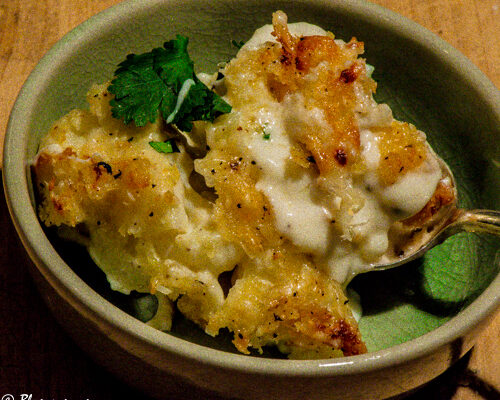
  I’m in love with this dish. What’s so special? First, it is a gratin. What is not to love?  Second, it has hints of lemon and thyme–a flavor combination that elevates just about any dish in my opinion.  And, then, there is the cheese–the…

Fresh and Wild Mushroom Stew (for the good times)

The vocabulary word for today is umami. Now don’t go getting all “low energy” on me. I really don’t want to see any of you putting your heads down on your desks and hyperventilating like this is just too hard.          …

Knife Tips

Sorry not to have posted for a couple of weeks. My beloved dog, Juliet, has been sick and I’ve been worried sick about her. When I’m “worried sick,” I eat Rosarita refried beans right out of the can. It is my comfort/junk food.

She is feeling better. Me, too, and I’m beginning to feel like cooking again.

Here is a photo of my beautiful brown-eyed girl catching a well-deserved nap.

Juliet Eyes2223

On the subject of cooking, here is a link to an interesting post about choosing knives. If you don’t know a tang from a Santoku, you might want to read on.

Years ago, I bought my first serious set of knives, Wusthofs, at the now defunct Fedco store (Anyone else wistfully remember that store?). I think my actual first set of knives probably came straight out of Pic’n’ Save.

I just checked the knife block in my kitchen and most of those original Wusthofs are still in use. Maybe it is time to upgrade. After all, those sublimely-balanced Santoku knives advertised by the big cooking stores are as beautiful as a piece of kitchen art. On the other hand, my Wusthofs are like old friends–comfortable and reliable, if not quite as sharp as they used to be. (I hope my old friends will forgive me. The knife joke was just too good to pass up.)

If you do decide to upgrade your knife collection, most cooking stores now carry a dazzling array of expensive and beautiful knives–knives far too costly to risk making an uninformed choice. That G-Fusion Santoku knife pictured in the Tribune article, for example, retails for $319 and Williams Sonoma is advertising a ten-piece Michel Bras knife set with blades coated in titanium for $3080. (If I remember correctly, my family’s 1963 VW cost about $1900 new off the lot.)

Who would ever have imagined paying that much for knives?

How to buy a knife from Chicago Tribune

Persian Eggplant Sandwich and A Serious Cookbook Addiction

Is there a support group for compulsive cookbook buyers? Hundreds of cookbooks share my office bookshelves with my collection of history and political science books from my thirty-two year teaching career and my growing collection of photography books. My history books are sacred possessions but I’m…

An international ice cream primer…

  I thought this was interesting. I’m not sure about that German Spaghetti-Eis, though! Ice Cream Around The World

Life Is Beautiful Bread Soup

fp-fdr-eleanor-rsvlt608

My husband used to tell me about his father making bread soup for him and his mother during The Great Depression–bread and milk and that was it.

As my husband told it, the family sat around their kitchen table and a had a “Life Is Beautiful” moment, coping with the reality of their empty shelves by pretending they were feasting.

Not having lived through The Great Depression myself (I’m a boomer), it was/is hard for me to comprehend the degree to which the privations of that period impacted people’s lives. It is clear to me that the dire shortages of food left an indelible mark on lives lived during those awful times, but I believe there are events in history that you have to experience to truly understand. I’m sure that is true for people who lived through the horrors of WWII and the injustice of Japanese Internment and for people who lived under Jim Crow in the South. I suspect that that is true now for people (me included) who lived through September 11 and, watching the catastrophe unfold, wondered what was in store for our nation. What, indeed?

I’m attaching a book review that ran in this week’s NY Times. The book, A Square Meal, was written by a husband and wife team of food historians, Jane Ziegelman and Andrew Coe, and chronicles the myriad ways people, like my husband’s family, coped with food issues during The Great Depression.

The Times‘ reviewer, Steven Kurutz, calls the book “a feast of historical tidbits,” and includes several historical anecdotes in his review.  I found it interesting that gourmand Franklin Roosevelt, with a stiff nudge from Eleanor, committed himself to set an example for the nation by eating humbly in the White House. Early in his first term, for example, it was pointedly shared with the press that FDR was served a modest meal of deviled eggs in tomato sauce and prune pudding while working at his desk in the Oval Office.

Reading Kurutz’ review piqued my interest and sent me off among my books and to internet sites to read more about food and the FDR kitchens.

I found an article in The New Yorker Magazine about the dismal state of cuisine in FDR’s White House that portrays the historic lunch that Ziegelman and Coe describe with a little less varnish:

“The meal started abruptly, with a main course of stuffed eggs, prepared as plainly as possible by mashing five hard-cooked yolks with a teaspoon of vinegar and half a teaspoon of minced onion. A thin coat of tomato sauce covered the eggs, which were served hot, accompanied by mashed potatoes and whole-wheat bread. Dessert was a small portion of pudding made chiefly from prunes, flour, and water. Festive it wasn’t; nevertheless, this was luncheon for six at the White House on March 21, 1933, less than three weeks after Franklin Delano Roosevelt’s first Inauguration. The President, a sophisticated and enthusiastic food lover, was not at the table. He had asked for a tray in his office, and later said that the meal had been “good.” But for Eleanor Roosevelt, proudly presiding at the lunch, “good” didn’t begin to address it. She had been planning the White House meals since well before the Inauguration, commissioning nutritious, low-cost menus from the home-economics faculty at Cornell, in the hope of making the White House a demonstration project for conscientious cookery during the Depression. It was a personal triumph to see one of these humble, wholesome meals served on White House china—two courses for only seven and a half cents per person, including coffee. She told the press that she and the President would be eating this way regularly.”

When the Roosevelts moved into the White House in 1933, Eleanor hired Henrietta Nesbitt, a political ally with no formal training in cooking or hotel management, to serve as the chief housekeeper. Mrs. Nesbitt had been a church friend and League of Women Voters friend in Hyde Park and, when Nesbitt’s husband lost his job during the Depression, Roosevelt had hired her to bake homemade breads and cakes for the Roosevelt household in New York. Mrs. Nesbitt had a pretty thin resume when Eleanor tapped her for the White House job.

Prickly-tempered and arbitrary, Nesbitt quickly alienated the White House kitchen staff and, although FDR joked that he hoped to win a fourth term just so that he could fire Nesbitt, she served the administration throughout Roosevelt’s tenure. Day after day, year after year, Nesbitt turned out meals for the First Family that were, as The New Yorker described them, “…so gray, so drooping, and so spectacularly inept that they became a Washington legend.”

Ernest Hemingway, a White House dinner guest in 1937, complained that the meal he was served was the worst he had ever eaten.  “We had a rainwater soup followed by rubber squab, a nice wilted salad and a cake some admirer had sent in. An enthusiastic but unskilled admirer.”

To be fair, Nesbitt was saddled with a very tight budget and a mandate from Eleanor Roosevelt to run a plain and sober White House during tough times. Too, she worked for a First Lady whose palate has been described as being “made of the same steel as her moral constitution.” Nevertheless, Nesbitt oversaw a White House cuisine that was remarkable for its dreariness-lots of cheap cuts of meat (including brains, sweetbreads and tongues), lots of jello molds and marshmallow-decorated deserts that drew snickers from guests.

Presidential lunches were a particular irritation for FDR with the same dishes cycling endlessly onto the President’s plate–broiled kidneys on toast, chipped beef on toast, shrimp wiggle on toast (shrimp wiggle?), curried eggs on toast, creamed chicken, creamed beef, creamed celery, broiled sweetbreads, braised sweetbreads, creamed sweetbreads, creamed sweetbreads and mushrooms.

There were numerous leaks and a lot of gossip about the state of culinary affairs in the White House and FDR’s displeasure with his food. In 1937 The Times ran a headline:  “Same Menu Four Days Palls on Roosevelt.” The President had been served liver and string beans four days in a row. In her memoir, Nesbitt would later reveal that Eleanor had reassured her when the press ran the liver and string beans story, saying that FDR was “in a tizzy” from working too hard and that expressions like “The vegetables are watery” and “I’m sick of liver and beans” were mere figures of speech. Seems like a clearly-targeted remark to me, but it was a good try on Eleanor’s part to diffuse the situation.

Incredibly, when the most powerful man in the world asserted himself and asked for dishes he enjoyed, Nesbitt wielded a powerful and unalterable veto. He asked that chicken a la king be put on the menu for the fourth inaugural luncheon; Mrs. Nesbitt served chicken salad. He asked for coffee; she sent iced tea. You get the picture. It was a war of wills. 

There is another possible explanation for the fact that FDR was regularly served the modern-day equivalent of prison loaf. Blanche Wiesen Cook, in her biography of Eleanor Roosevelt, theorizes that Roosevelt, badly wounded by her husband’s dalliances early in their marriage, may have used food and Mrs. Nesbitt as  weapons. Cook writes, “ER’s curious disregard for her husband’s tastes suggests an explanation for her persistent defense of Henrietta Nesbitt: The housekeeper was one expression of her passive-aggressive behavior in a marriage of remarkable and labyrinthine complexity.”

The New Yorker ran this cartoon with a caption that explained that those invited to dine with the Roosevelts learned a lesson from the FDR White House– eat before you go.

101122_r20183_p886-860-1200-07160312


Here is the recipe for the prune pudding.

Eleanor’s Prune Pudding

Here is the book review:

NY Times Review of A Square Meal

Here is a photo of FDR, Eleanor Roosevelt and Fala that I have always liked. I can’t know for sure, but I suspect Fala found a lot of sweetbreads and liver in his food bowl.

1US-10-F1941-4 (966281) Franklin and Eleanor Roosevelt with dog Roosevelt, Franklin D.; 32th President of the USA (1933-45); Hyde Park (N.Y., USA) 30.01.1882 - Warm Springs (USA), 12.4.1945. - Franklin Roosevelt and his wife Eleanor with their Scotch terrier Fala on the terrace of his house in Hyde Park, New York (USA). - Photo, 1941. (Newscom TagID: akgphotos260251.jpg) [Photo via Newscom]


Basil Vinaigrette

      There I was, like a jilted bride ditched at the altar, clutching a huge bouquet of leafy emerald green sweet basil and wondering what the heck to do next. Believe me, I had no plans for any major cooking projects using basil…