TED Talk About Food, Taste and Spaghetti Sauce
Interesting (and entertaining) TED talk about food and how we taste it.
Food, Photography and Bons Mots
Interesting (and entertaining) TED talk about food and how we taste it.
I love curry. Fragrant and spicy, every time I have a bowl of curry it brings back wonderful food memories. I’ve been fortunate to travel a good deal in my life–a lot of it in India. I’ve eaten curries in Mumbai, Delhi, Agra, Srinagar,…

Sad.
Seasonal Affective Disorder (SAD). That kind of sad.
That’s what I think has been causing my sense of self worth to crater for the last week. Those menacing dark clouds and torrential rains may have nourished my garden, but they sure tipped my mood toward melancholia.
When I’m blue, I get food cravings. Big ones. Often, it is refried beans–straight out of the can. More times than I want to admit, it’s been gorgonzola. This week’s craving has been for oatmeal cookies–a favorite indulgence from my childhood. As a little girl, I could put away a whole package of those crisp flat oatmeal cookies that came right off the supermarket shelves.
Lest I feel guilty about my cookie indulgence, I want to say up front: oats are good for you! I know. I know. It’s a cookie. But still.
Sages from the ages, Hippocrates and Galen among them, have noted the healing properties inherent in oats, giving oats credit for everything from curing a cold to acting as a desiccant for the skin. More recently, scientific evidence has identified oat and oat bran consumption as an effective tool in the fight against heart disease.
Despite long-held beliefs that oats were a part of a healthy human diet, the early cultivation of oats was skewed towards feed grain for animals. In fact, until the 19th century, only the Irish and the Scots incorporated oats as a regular and significant part of their diets.
According to a publication about oats by The American Association of Cereal Chemists (Yes. There is such a group.), the consumption of oats by the Scots led to a dust up of sorts with the English. The AACC credits Sir Walter Scott with chronicling the details of that English-Scottish tiff and with uncovering what is undoubtedly history’s most famous quotation about oats. According to Scott, the renowned English writer Samuel Johnson, in a moment of puerility, described oats as “a grain which in England is generally given to horses, but in Scotland supports the people.” Johnson’s slur drew blood in Scotland and a prominent Scottish nobleman, Lord Elibank, responded to Johnson’s insult with a bit of trash talk, replying: “True, but where can you find such horses, where such men?” Take that, Samuel Johnson!
So, it goes to figure that it was Scottish settlers who brought oats to North America. Interestingly, because oats were believed to be a food for the infirm, most oatmeal was sold in pharmacies in those early days Gradually, oats got a reputation as a healthy breakfast cereal for broader public consumption and was moved to the grocery aisles.
Here is a very good recipe for oatmeal cookies. It’s easy. It’s quick. There are lots of healthy oats. You’ll feel better.
Me? It’s drizzling here this morning but, sitting here with a plate of warm cookies, a steaming hot cup of tea, and a dozing sweet Juliet in my lap, I’m seeing nothing but blue skies. Life is good.

The original recipe appeared on the AllRecipes site. A link to that recipe appears at the end of this post.
20 minPrep Time
15 minCook Time
35 minTotal Time
 Save Recipe
Ingredients
Instructions
Here is the link to the original recipe:
After decades of procrastinating, I bought some sourdough starter from King Arthur Flour. Sourdough starter is “a fermented dough retained from one baking to another,” according to their site. For $8.95, King Arthur sent me a small plastic jar containing one ounce of their…
I confess that making risotto isn’t (or hasn’t been) a strong suit for me. Don’t get me wrong, I love rice. It is just that, somehow, risotto always seemed like it would be complicated to prepare. Then my world changed. I got an…
I have a parrot, actually an umbrella cockatoo, named Moti. Moti is twenty-seven years old and quite the diva, especially about her food. In Moti’s world there is no sunshine if she doesn’t find a half a banana in her food dish each morning. Moti is quite a foodie, too. She holds the banana in her claw with the cut side up and puts pieces of her other food on top of the banana so that she can mix the foods together as she eats. Smart Moti.
Bananas are a very healthy part of any diet–human or avian. They are low in calories at approximately 110 calories per banana. They are fat free. A banana gives you 18% of your body’s daily requirement for potassium and 15% of your Vitamin C. Interestingly, bananas are also rich in tryptophan, that mood-elevating neuro transmitter that can also help you fall asleep. What’s not to love?
Try as we may, though, Moti and I can’t seem to keep up with the bananas in our fruit bowl. We always seem to have some disgusting overripe ones. We can only eat so much banana bread (another of Moti’s fav foods–especially baked with lots of walnuts). What to do?
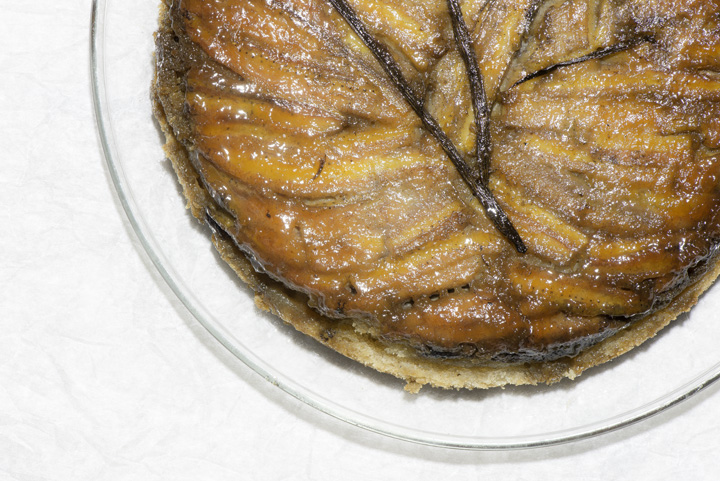
I recently saw this banana upside down cake recipe on David Lebovitz’ blog and I knew that I had to try it. It didn’t disappoint. It is rich and beautiful– a cinnamon and vanilla flavored cake underneath a very pretty caramelized banana crown.

By the way, bananas are the fourth largest fruit crop in the world (after grapes, citrus fruit and apples). Per capita, Americans consume an average of twenty-seven pounds of bananas each year. Whoa! That’s a lot of bananas.
Here is your banana trivia question for the day. Is a banana (a) a legume (b) a berry ( c) a grain (d) a nut? You got it right if you chose answer “b.” Bananas are the seedless berries of a tree-sized herbaceous plant commonly, and incorrectly, referred to as a banana tree.
Trivia question number 2: Is a bunch of bananas referred to as (a) a hand (b) a finger ( c) a foot (d) an elbow? Count yourself correct if you answered (a) a hand. The individual bananas are called “fingers.” I knew you would find that fascinating.
Trivia question number 3: Banana peels can be used for which of the following purposes? (a) polishing your shoes (b) rubbing on your forehead to relieve a headache ( c) fertilizing your roses (d) all of the above. The correct answer, according to the banana experts, is (d). Who knew?
You will find a link to Lebovitz’ blog at the end of this post.
Yields 10-12 servings
30 minPrep Time
30 minCook Time
1 hrTotal Time
Save RecipeIngredients
Instructions
Notes
My cake was prettiest on the day it was baked. On day two, the bananas began to darken.
Here is a link to David Lebovitz’ blog and to the original recipe:
http://www.davidlebovitz.com/banana-upside-down-cake-recipe/
During the Middle Ages, rich European ladies slipped their favorite knights a bit of gingerbread before an important tournament. Sweet, aromatic, crumbly, swoon-worthy gingerbread. How utterly romantic is that!? If you need proof, the painting below portrays a lady and her knight. Theirs was…
Uh-oh! I’m in a dangerous place. I’m binge cooking cookies. Fortunately, I have neighbors who are willing to humor me and take some of my cookie glut off my hands. I recently posted a chocolate cookie recipe from Dorie Greenspan’s new book, Dorie’s Cookies. Now…

OK everyone. All together now. Say cowpeas.
That’s what black-eyed peas are. They are a type of cowpeas, “one of the most ancient crops known to man” according to Purdue’s horticultural Jefferson Institute, and the real shocker is that they aren’t really peas at all. Instead, they are an African relative of the mung bean. Who knew?
Cowpeas are believed to have been introduced to the United States via the slave trade. And, as the story goes, the consumption of black-eyed cowpeas later became a New Year’s day tradition in the South as a result of the Civil War. According to Texas A and M’s website, the 40-day siege of Vicksburg left residents of that area on the verge of starvation and was illustrative of Southern food shortages and suffering during the war. As the Northern armies scoured the countryside for food, they apparently left the black-eyed cowpeas in the fields, thinking they were good only as animal feed. Southerners knew otherwise. Once the war was over, the consumption of black-eyed peas (along with greens and cornbread) on January 1 became a Southern paean to survival both for southern whites and for newly-emancipated blacks.
Over the years, the New Year’s Day peas-greens-cornbread meal has also taken on other meanings. The three foods are humble food, so it is said that eating them on the first day of the year acknowledges one’s humility. Also, the black-eye has come to be associated with finding prosperity and wealth in the new year. As the saying goes, “peas for pennies, greens for dollars, cornbread for gold.” Some even believe that you need to eat exactly 365 black-eyed peas on January 1 to ensure that prosperity. (That’s a little less that 2/3 C. of dried beans. I was curious how onerous the 365 rule was and I counted.– I know. I know. I have no life. Even sweet little Juliet thought I was out of my mind as I counted the little dried cowpeas one by one.)
Today, the world’s largest crops of cowpeas are cultivated in Africa where Nigeria and Niger are leading producers, but black-eyed cowpeas are grown all over the world and are a major crop here in California. Worldwide, it is estimated that 1.24 million tons are grown from dry seed each year. That’s a whole lot of cowpeas.
No doubt a big part of the world-wide popularity of cowpeas is their ease of cultivation. The plants have a deep taproot that makes them more tolerant of drought and heat than other beans. Nutritionally, you get a lot of bang for your buck, too. Low in saturated fat, cholesterol and sodium, they are a good source of protein and fiber. In fact, a serving of cowpeas provides about the same protein as 2 ounces of meat.
I was searching around for an interesting recipe for black-eyed peas for my New Year’s meal and came across this Black-Eyed Pea Salad recipe. I enjoyed the addition of diced sweet potatoes to the black-eyes and was really taken by the tangy vinegar dressing that is tossed with the mixture.
Best wishes for a great new year. Remember to eat your black-eyed peas. Many of you missed the traditional January 1 meal, but it still can’t hurt to eat a few cowpeas for luck. A little prosperity couldn’t hurt either!
The link to the original recipe from which this recipe was adapted appears at the bottom of this post.
Save RecipeIngredients
Instructions
Notes
The black-eyed peas absorb most of the dressing. I found that adding additional dressing to the beans just before serving gave the salad a boost.
I most enjoyed this salad served slightly warm or at room temperature.
This recipe was adapted from a recipe that originally appeared on the Sweet Savant website. Here is a link to that recipe:
I’m having a bit of a pity party about being alone on New Year’s Eve, so I decided to cook today. Several days ago I discovered this Martha Rose Shulman recipe on the New York Times site. One of my indulgences in life is…