Which “vegetable” is actually a berry, has the highest nicotine content among all vegetables, and is 95% water? (Hint: Chinese ladies once used the dye extracted from this vegetable’s skin to polish their teeth to a then-fashionable gray hue.)
It’s the eggplant. Who knew? (Don’t worry about the nicotine part, by the way. You would have to consume 20 pounds of eggplant to get the amount of nicotine in a single cigarette. That is more eggplant than even eurysome Chris Christie could eat in one sitting.)
Also called a brinjal (India), a melanzana (Italy) and an aubergine (France), the eggplant is a member of the nightshade family that includes tomatoes and potatoes. Native to Asia, the eggplant was introduced into Europe via Mediterranean trade. Thomas Jefferson is credited with introducing the eggplant to American tables and grew plants in his Virginia garden.
Historically, the reputation of the eggplant is a mix. On the one hand, there is a charming Japanese proverb that enthuses about dreaming of eggplant on New Year’s Eve: “The happiest omen for a new year is first Mt. Fuji, then the falcon, and lastly eggplant.” (I’m trying to imagine the storyline of such a dream. It might go something like this… With a cloud-shrouded Mt.Fuji looming majestically in the background, a solitary falcon soars soundlessly above the landscape. Suddenly, spotting its prey, the falcon stops mid-air and then swoops from the sky, only to find that he has targeted a single purple eggplant. Bummer for the falcon. No! Wait! The curious falcon notices that the eggplant is glowing–an enchanted orb. Then, before the world-weary falcon’s eyes, the eggplant transforms into a lovely purple-gowned princess. The princess promptly falls in love with the lonely falcon and bestows upon him a single magical kiss whereupon the falcon morphs into a handsome Japanese prince. And today, if you look ever so carefully, you can see them– two lovers standing in luxuriant fields of eggplants growing on the slopes of Mt. Fuji and pondering their good fortune in life. The prince is now a wealthy anime mogul and the princess operates an elegant ryokan named L’aubergine. <cue the music>)

On the other hand, Medieval Europeans were wary of consuming eggplant, believing it was a poison that could cause madness. (The Italian word for eggplant is a variation on the term mad apple.)
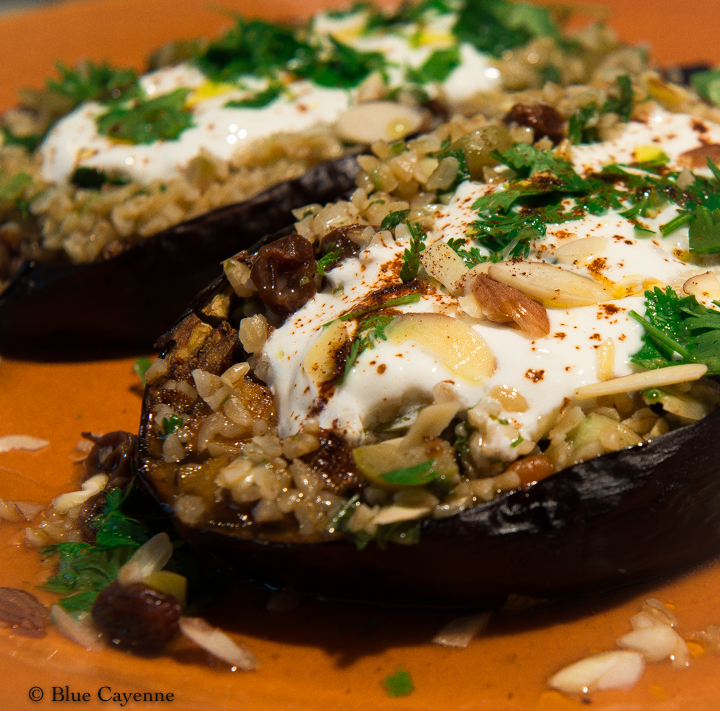
The high season for eggplants is August to October, so you will find an abundance of eggplants (there are more than twenty varieties) in markets at the moment, and this recipe, adapted from Ottolenghi’s well-regarded cookbook Jerusalem, is both a delicious and beautiful way to ease into eggplant season.
Wishing you handsome princes and eggplant dreams.
[mpprecipe-recipe:74]
Here is a link to Amazon and Ottolenghi’s book: Yotam Ottolenghi’s Jerusalem cookbook.